
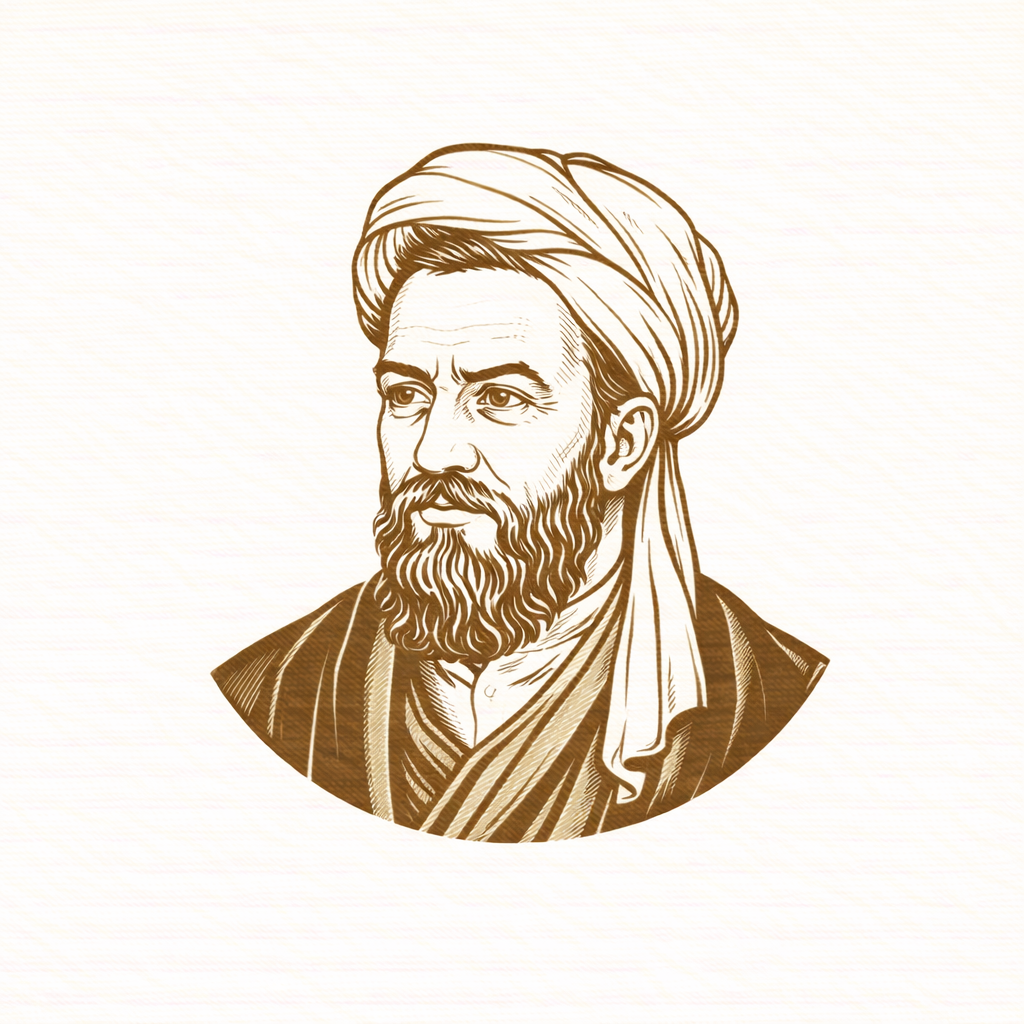
The Philosopher Who Set Existence in Motion
He was born in Shiraz in 1571, the only son of a wealthy provincial governor, into a Persia that had recently become Shiʿa under the Safavid dynasty and was reopening old dialogues between Greek metaphysics, Avicennan philosophy, and Islamic mysticism. He received the education of a prince: Arabic grammar, Qurʾanic exegesis, hadith, logic, and the inherited tradition of Ibn Sina's Peripatetic philosophy. He studied in Isfahan under the two greatest thinkers of the Safavid court, Mir Damad and Shaykh Bahāʾi, and he absorbed everything they could teach him.
And then, because the tradition he had been handed did not satisfy him, he left.
He withdrew to a remote village called Kahak, near Qom, and lived there for perhaps fifteen years in near-total seclusion. He prayed, fasted, walked the hills in silence, and thought. What he thought about was the oldest question in philosophy: what does it mean for something to exist? Ibn Sina had distinguished between essence — what a thing is — and existence — that the thing is. The Peripatetics had treated essence as primary: existence was a mere accident, a predicate added to an already-defined nature. Mulla Sadra, in the silence of Kahak, reversed this. Essence, he concluded, was a mental abstraction. Existence was the only reality. What we call 'a stone' is not a thing that happens to exist; it is an act of being, a pulse of existence, that the mind clips into the static outline we call 'stoneness.'
This became the doctrine of aṣālat al-wujūd, the primacy of existence. And from it he drew his most startling conclusion: if existence is the only reality, and if existence is dynamic rather than static, then everything — not just rivers and seasons and living bodies, but stones, stars, mountains, the human soul — is in continuous substantial motion. He called this al-ḥaraka al-jawhariyya, substantial motion. A thing is never the same thing twice. The world is not a collection of nouns. It is a tissue of verbs.
When he finally emerged from his seclusion, he had composed the book that would become the most important work of Islamic philosophy written in the past thousand years: al-Asfar al-arbaʿa, The Four Intellectual Journeys. It is a vast work — nine volumes in modern editions — and it weaves together Aristotelian logic, Avicennan metaphysics, Ibn ʿArabi's mysticism, and the Shiʿa tradition of gnosis into a single system of extraordinary ambition. He called the synthesis al-Ḥikma al-Mutaʿāliya, Transcendent Theosophy: a philosophy that aimed to reconcile reason, revelation, and mystical experience as three modes of a single act of knowing.
He returned to Shiraz, taught a handful of devoted students, and died on his seventh pilgrimage to Mecca in 1640. In the West he remained almost entirely unknown until the twentieth century, when Henry Corbin, a French scholar working in Tehran, spent forty years translating and commenting on his work. Today he is recognized as one of the great metaphysicians in any tradition — a philosopher who insisted, four hundred years ago, that reality is not a thing but a happening, that being is a verb, and that the universe is always in the middle of becoming itself.
A thing is never the same thing twice. The world is not a collection of nouns. It is a tissue of verbs.
“Existence is a single reality; essences are merely its mental shadows.”
Key Ideas
Primacy of existence (aṣālat al-wujūd)
Substantial motion (al-ḥaraka al-jawhariyya)
Gradation of being (tashkīk al-wujūd)
Unity of the intellect and the intelligible
Key Works
- 01al-Asfar al-arbaʿa (The Four Intellectual Journeys)
- 02al-Ḥikma al-ʿArshiyya (The Wisdom of the Throne)
- 03al-Shawāhid al-Rubūbiyya (Divine Witnesses)
- 04Mafātīḥ al-Ghayb (Keys of the Unseen)
Intellectual Lineage
Did you know
Mulla Sadra was driven out of Isfahan for teaching doctrines the orthodox clerics found unacceptable. He spent fifteen years in near-total seclusion in a remote village called Kahak, where — as legend has it — he prayed, fasted, and walked the hills in silence until he had rethought the foundations of metaphysics.