
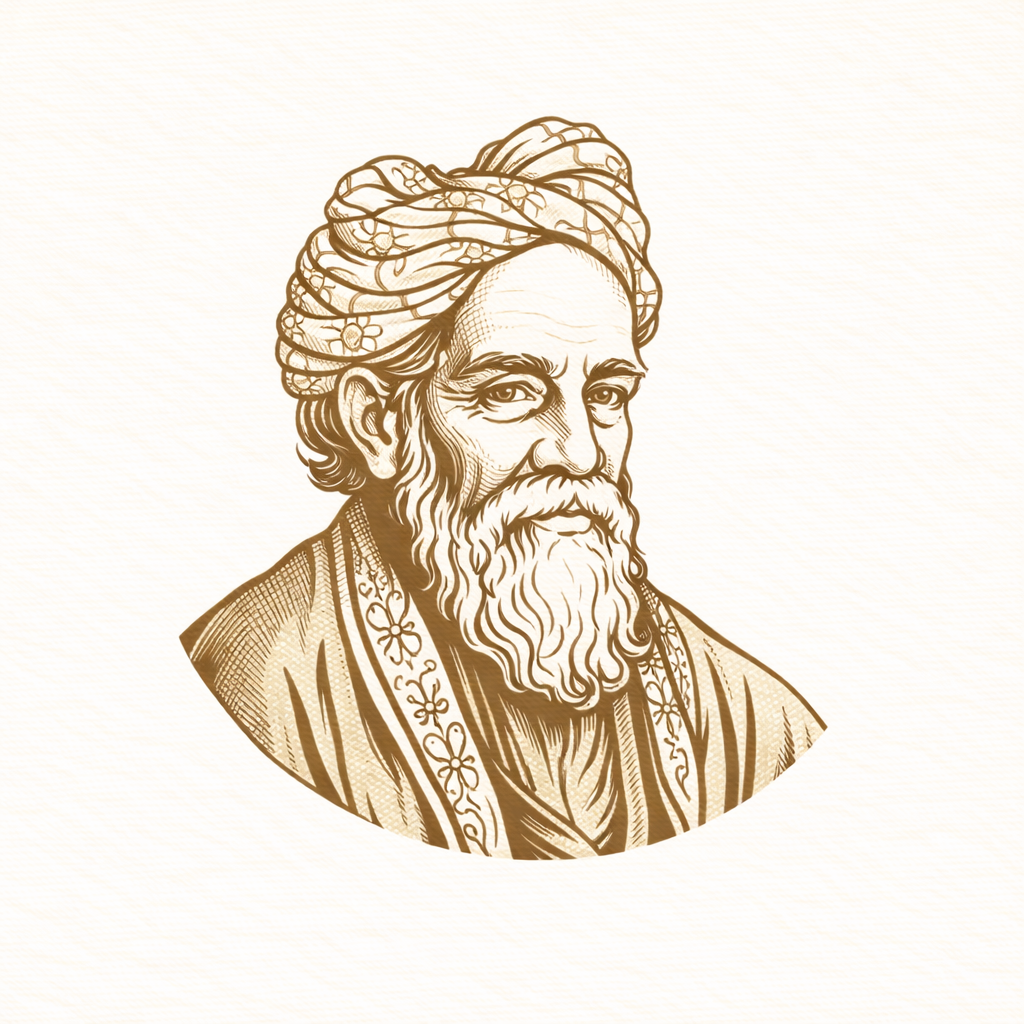
The Mathematician Who Wrote About Wine
He was born in Nishapur, a city of turquoise and learning on the old Silk Road, in the year 1048 — a generation after Avicenna had died and a half-century before the Crusades would set Christendom marching east. His father was a tent-maker, which is what his name would come to mean in Persian: Khayyam, the son of a tent-maker. But the boy who grew up in that household was drawn not to canvas and rope but to numbers, to stars, and to the hard metaphysical questions that his teachers told him were dangerous.
By the time he was thirty he was the greatest mathematician of his age. His treatise on algebra — written in Arabic, as all serious scientific prose was in the eleventh century — gave the first general classification of cubic equations and a geometrical method for solving them using the intersection of conic sections. This was eight hundred years before Descartes. No one in Europe would touch the problem at that level of generality until the sixteenth century.
In 1074 the Seljuk sultan Malik-Shah summoned him to the new observatory at Isfahan and asked him to reform the calendar. Khayyam and his team measured the length of the tropical year to five decimal places and designed the Jalali calendar, which was put into use in 1079 and was more accurate than the Gregorian calendar that would replace the Julian half a millennium later. Its error is roughly one day in five thousand years.
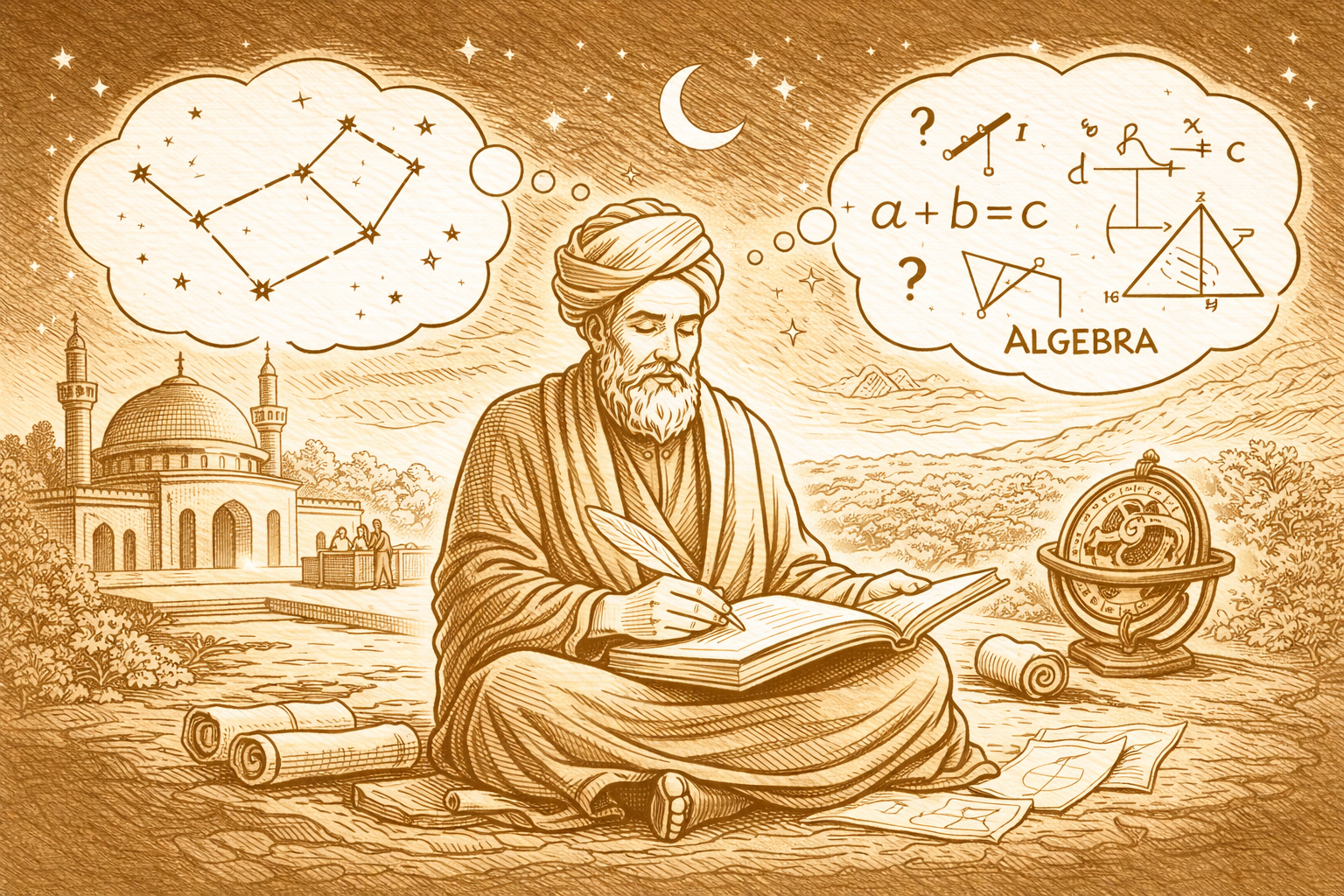
And yet none of this is what made him famous in the English-speaking world. What made him famous were the quatrains — the rubaiyat — short four-line poems that he seems to have written privately, in Persian, for his own eyes and a small circle of friends. They are scandalous, tender, skeptical, and suffused with a weary joy. They are about wine and bread and the shortness of life and the silence of God. 'The moving finger writes,' one of them says in Edward FitzGerald's nineteenth-century English translation, 'and having writ, moves on: nor all thy piety nor wit shall lure it back to cancel half a line.' Another: 'Ah, make the most of what we yet may spend, before we too into the dust descend.'
Orthodox Muslims found the poems unsettling — they celebrated wine in a religion that forbade it, and they shrugged at the afterlife in a culture that staked everything on it. Khayyam was probably not an atheist, but he was something equally scandalous for his time: an honest skeptic who looked at the world as it was and refused to pretend otherwise. 'I cannot lift the mystery's veil,' he wrote. 'I am neither rebel nor believer — I am just someone who has thought.'
He died in Nishapur around 1131, and was nearly forgotten for seven hundred years in the West. Then, in 1859, a quiet English scholar named Edward FitzGerald published a slim volume of loose translations called The Rubaiyat of Omar Khayyam. At first nothing happened. The book sat in a bargain bin for years until Dante Gabriel Rossetti picked up a copy for a penny and passed it around London. Within a generation it had become one of the most beloved books in the English language. Presidents quoted it. Soldiers carried it into the trenches of the First World War. The boy from Nishapur — a mathematician who had measured the year to five decimals and had written verses for himself, alone — had reached across nine centuries and a dozen languages to become something his strict teachers would never have imagined: a friend.
He was an honest skeptic who looked at the world as it was and refused to pretend otherwise.
“The moving finger writes; and, having writ, moves on: nor all thy piety nor wit shall lure it back to cancel half a line.”
Key Ideas
Skeptical empiricism in the face of religious dogma
Carpe diem — the imperative of the present moment
Mathematical solutions to cubic equations via conic sections
The impermanence of life and the silence of the heavens
Key Works
- 01Rubaiyat (Quatrains)
- 02Treatise on Demonstration of Problems of Algebra
- 03Commentary on the Difficulties of Certain Postulates of Euclid's Work
- 04On the Scientific Method and the Study of Algebra
Intellectual Lineage
Did you know
Khayyam designed the Jalali calendar in 1079, calculating the length of the tropical year to five decimal places. It is more accurate than the Gregorian calendar that replaced the Julian five centuries later — its error is about one day in five thousand years.